Categories
Personal Growth Wellbeing

The Power of Listening in a Noisy World: Compassion, Connection and Self-Awareness


We live in a world that often encourages us to speak quickly, react immediately, and share our opinions before fully understanding what is being said. Social media, news headlines, and everyday conversations can sometimes leave little room for reflection. Yet one of the most valuable skills we can develop is surprisingly simple: listening.

Listening is at the heart of meaningful relationships. It helps us understand ourselves, connect with others, and navigate life’s challenges with greater awareness and compassion. In counselling and psychotherapy, listening is often considered one of the most important therapeutic skills. However, its value extends far beyond the therapy room.

Many of us have experienced what it feels like to be truly listened to. There is something deeply affirming about being heard without interruption, judgement, or the pressure to provide the “right” answer. Equally, most of us have experienced conversations where we felt misunderstood, dismissed, or unheard.

Listening is not simply waiting for our turn to speak. Genuine listening involves curiosity, presence, and a willingness to understand another person’s perspective. It requires us to pause, pay attention, and sometimes set aside our own assumptions.

Before we can listen effectively to others, we often need to learn how to listen to ourselves. Self-awareness begins when we take time to notice our thoughts, feelings, reactions, and needs. Many people spend their lives responding to external demands whilst paying little attention to their inner world. Yet personal growth often begins when we slow down enough to hear what is happening within us.

Listening to ourselves can help us recognise when we are tired, overwhelmed, anxious, hurt, or in need of support. It can also help us identify our strengths, values, hopes, and aspirations. The more aware we become of our own inner experiences, the better equipped we are to understand the experiences of others.

Listening also invites compassion. When we truly listen, we often discover that beneath disagreements, frustrations, and differences lie common human experiences. Most people want to feel valued, understood, respected, and connected. Remembering this can help us approach others with greater kindness and empathy.

Compassion is not only something we offer to others. It is also something we can offer to ourselves. Many individuals speak to themselves in ways they would never speak to a friend. Self-compassion encourages us to respond to our struggles with understanding rather than criticism. It reminds us that being human involves making mistakes, experiencing setbacks, and facing uncertainty.

The Serenity Prayer offers a timeless reminder:

“Grant me the serenity to accept the things I cannot change, courage to change the things I can, and wisdom to know the difference.”

There is great wisdom in these words. Much of our stress comes from attempting to control things beyond our influence. Acceptance does not mean giving up. Rather, it means recognising reality as it is and focusing our energy on what we can do.

Another simple but powerful principle is to take life one day at a time. Many of us spend significant energy worrying about what might happen tomorrow. Yet tomorrow often unfolds differently from what we imagined. Bringing our attention back to the present moment can help reduce anxiety and increase our appreciation of what is already here.

The words, “Do not worry about tomorrow, for tomorrow will worry about itself,” remind us that we are not required to solve every future problem today. Sometimes the most helpful step is simply to focus on the next right thing in front of us.

In challenging times, it can be easy to become overwhelmed by conflict, uncertainty, and negativity. Yet beauty, kindness, and goodness still exist around us. A conversation with a friend, a walk in nature, a blooming flower, an act of generosity, or a moment of quiet reflection can remind us of what matters most.

Perhaps the invitation is simple:

Listen more.

Listen to yourself.

Listen to others.

Pause before reacting.

Choose kindness where possible.

Practice compassion for yourself and for those around you.

And remember that whilst we may not always be able to change the world, we can influence the way we respond to it.

Sometimes that is where meaningful change begins.

Reflection Questions

  • When was the last time you felt truly listened to, and what made that experience meaningful?
  • How well do you listen to yourself when you are feeling stressed, overwhelmed, or emotionally challenged?
  • Are there situations where you react quickly rather than pause and reflect? What might change if you gave yourself more time before responding?
  • How do you typically speak to yourself when things go wrong? Would you speak to a friend in the same way?
  • What assumptions do you sometimes make about others, and how might greater curiosity change your understanding?
  • What is one thing in your life that you need to accept, and one thing you have the courage to change?
  • Looking back on this week, what have you learned about yourself through your interactions with others?
  • What small act of kindness could you offer yourself or someone else today?
Categories
Anxiety & Overthinking Emotional Awareness Emotional Wellbeing Mental Health Personal Growth Self-Reflection

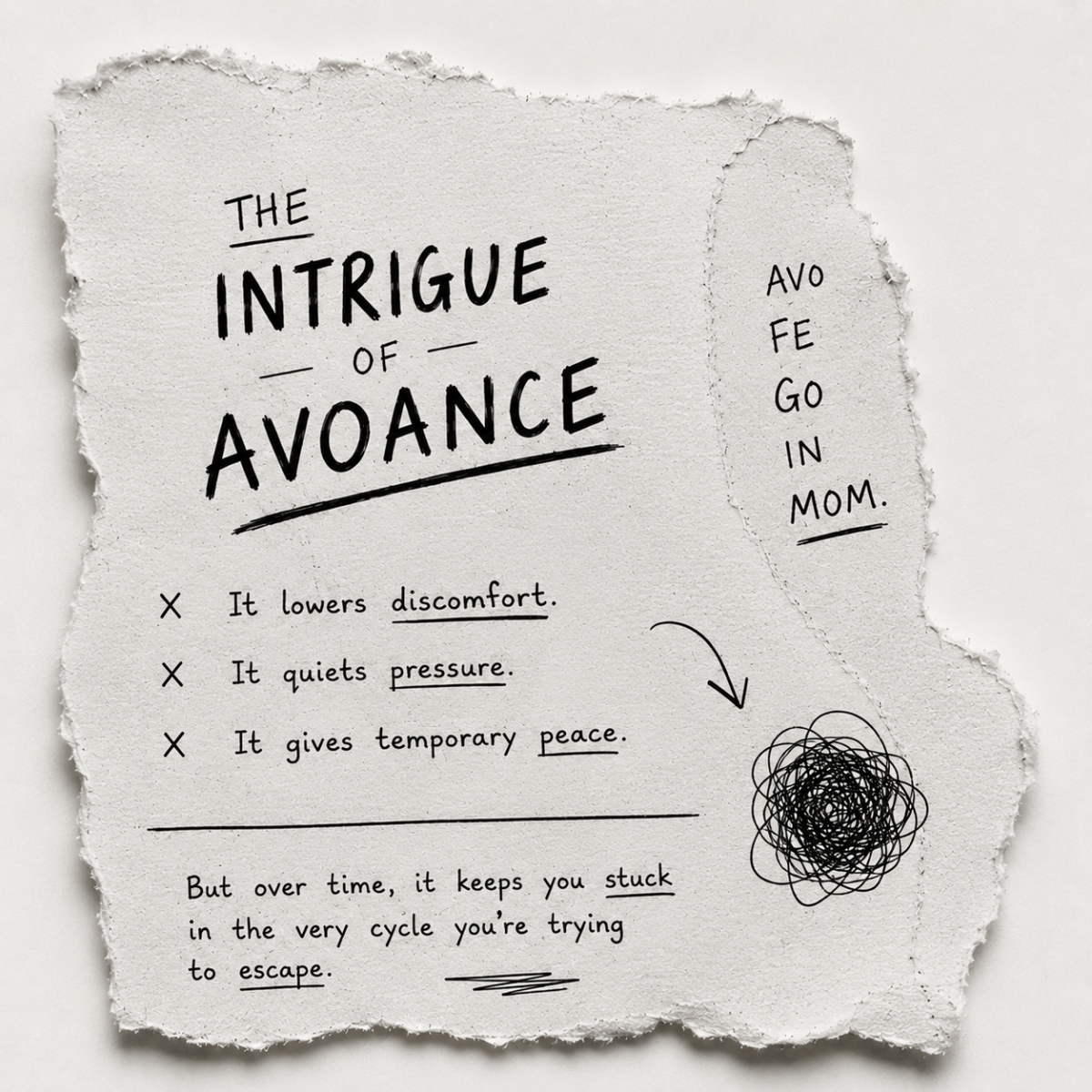
The Intrigue of Avoidance


Avoidance often feels good in the moment.

It lowers discomfort.
It quiets pressure.
It gives temporary relief from difficult emotions, responsibilities, conversations, or fears we do not yet feel ready to face.

But over time, avoidance can quietly keep us stuck in the very cycle we are trying to escape.

The more we avoid:

  • the heavier things can begin to feel,
  • the louder anxiety may become,
  • and the harder it can feel to begin again.

Avoidance is not always laziness or lack of motivation. Sometimes it is emotional protection.

Sometimes we avoid because we feel overwhelmed.
Sometimes because we fear failure, judgement, rejection, conflict, or disappointment.

Gentle awareness can help us notice what sits underneath the avoidance rather than simply criticising ourselves for it.

Creative Reflection Questions

  • What am I currently avoiding emotionally?
  • What discomfort am I trying to escape?
  • What feels difficult about facing this situation?
  • What might happen if I took one small step instead?
  • What would a gentler response toward myself look like today?

Sometimes healing begins not with forcing ourselves forward, but with understanding what is making us stay still.

Categories
Anxiety & Overthinking Emotional Awareness Emotional Wellbeing Mental Health Motivation Personal Growth Reflective Practice Self Compassion

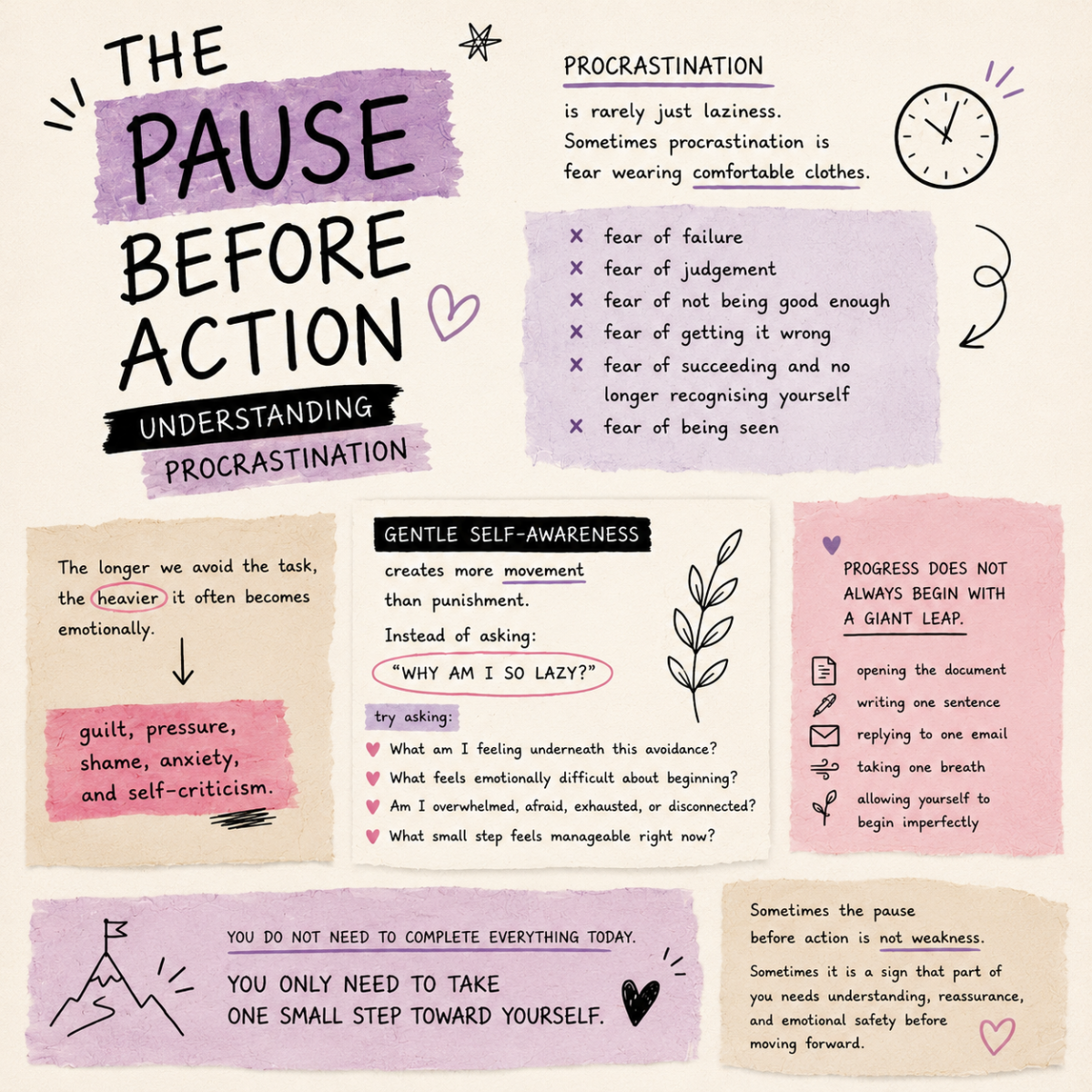
The Pause Before Action: Understanding Procrastination

Procrastination is rarely just laziness.

Sometimes procrastination is fear wearing comfortable clothes.

Fear of failure.
Fear of judgement.
Fear of not being good enough.
Fear of getting it wrong.
Fear of succeeding and no longer recognising yourself.
Fear of being seen.

The longer we avoid the task, the heavier it often becomes emotionally. What may have started as a small responsibility can slowly grow into guilt, pressure, shame, anxiety, and self-criticism.

Many people silently carry thoughts such as:

  • What if I fail?
  • What if it’s not good enough?
  • What if people judge me?
  • What if I disappoint myself?
  • What if I cannot cope once I begin?

Procrastination can sometimes act as emotional protection. Delaying the task delays the discomfort attached to it. For some people, procrastination develops from perfectionism, self-doubt, burnout, overwhelm, anxiety, or earlier experiences of criticism and pressure.

When we constantly feel we must perform perfectly, even starting can feel emotionally exhausting.

At times, procrastination may also reflect emotional exhaustion rather than lack of motivation. When individuals feel emotionally overwhelmed, disconnected, unsupported, or mentally drained, even simple tasks can begin to feel heavy.

The inner critic often becomes louder during procrastination:

  • You should be doing more.
  • Why can’t you just get on with it?
  • Everyone else seems able to cope.
  • You are falling behind.

But harsh self-criticism rarely creates sustainable motivation. More often, it increases anxiety, avoidance, shame, and emotional paralysis.

Gentle self-awareness can create more movement than punishment.

Instead of asking:

Why am I so lazy?

it can sometimes help to ask:

  • What am I feeling underneath this avoidance?
  • What feels emotionally difficult about beginning?
  • Am I overwhelmed, afraid, exhausted, or disconnected?
  • What small step feels manageable right now?

Healing procrastination is not always about becoming more disciplined. Sometimes it is about developing greater emotional understanding, self-compassion, and realistic expectations of ourselves.

Progress does not always begin with a giant leap.

Sometimes progress begins with:

  • opening the document,
  • writing one sentence,
  • replying to one email,
  • taking one breath,
  • or allowing yourself to begin imperfectly.

You do not need to complete everything today.

You only need to take one small step toward yourself.

 Reflection Questions

 What emotions tend to sit underneath my procrastination?

  • What am I afraid might happen if I begin?
  • Do I associate productivity with self-worth?
  • What would a gentler approach toward myself look like?
  • What is one small step I could take today without pressure or perfection?

Sometimes the pause before action is not weakness.

Sometimes it is a sign that part of you needs understanding, reassurance, and emotional safety before moving forward.


Categories
Creative Expression & Wellbeing Personal Growth

Nurturing Your Creative Self: Ways to Reconnect with Inspiration

As we move through times that feel heavier or more reflective, it can help to notice the small ways creativity supports us. Not in big, dramatic gestures, but in the quieter ones. It often sits nearby, waiting for us, like an old friend who doesn’t need everything explained.

During these moments, whether they’re emotional, transitional, or simply part of being human, it’s worth remembering that creativity isn’t distant or rare. It’s close. It responds to honesty. And at times, it becomes a gentle form of care.

Here are a few ways you might reconnect with your creative self and offer yourself some kindness along the way.

Let what you feel have a voice

Sometimes emotions need space rather than solutions. Creative expression can offer that space. A journal, sketchbook, or even a scrap of paper can become a private place for feelings to land safely.

Reflection: If your emotions had colours or shapes today, what might they be?

Choose comfort over pressure

Creativity doesn’t have to be ambitious. Simple, familiar activities can be deeply steadying, baking something warm, arranging photographs, or making something small with your hands.

Reflection: What gentle activity feels reassuring rather than demanding right now?

Invite lightness and play

A moment of humour can shift the atmosphere inside us. Playfulness loosens tension and reminds us that not everything meaningful has to be serious.

Reflection: What could you make purely for enjoyment, with no purpose other than to lift your spirits?

Step outside and notice

Nature has a quiet way of restoring perspective. A short walk, sunlight on your face, or simply watching the sky can soften mental noise and spark inspiration.

Reflection: What detail in nature catches your attention today?

Share moments with others

Creativity doesn’t always need to be solitary. Being around people who feel safe or encouraging can rekindle warmth and motivation.

Reflection: Who could you spend time with that helps you feel more like yourself?

Shape meaning from experience

Your thoughts, memories, and feelings can become material for expression, words, images, symbols, or sounds. Creating from lived experience can feel grounding and empowering.

Reflection: What theme feels personally meaningful to explore creatively this week?

Work with materials that feel freeing

Some materials invite spontaneity more than others. Quick sketches, loose brushstrokes, clay, collage, anything that allows movement without overthinking can help expression flow.

Reflection: Which materials help you feel most unrestricted?

Let your body participate

Movement can shift emotional energy and refresh perspective. Even gentle stretching or a slow walk can open space for new ideas.

Reflection: Where might a short wander or stretch take your imagination?

Create moments of stillness

Quiet pauses allow thoughts to settle. In that calm, creativity often returns naturally. Slow, repetitive art forms or mindful doodling can be especially soothing.

Reflection: What simple activity helps you settle into a peaceful focus?

Welcome fresh experiences

Trying something unfamiliar can gently awaken curiosity. A new place, a different art form, or a small change in routine can bring renewed energy.

Reflection: What small new experience could you offer yourself this week?

A Closing Thought

Creativity isn’t only about making something; it’s also a way of tending to yourself. When approached with gentleness rather than expectation, it becomes less about producing and more about connecting.

You don’t need perfect conditions to begin. Just a moment of willingness.

And perhaps that is one of the simplest acts of self‑kindness: showing up for yourself, exactly as you are.


Categories
Emotional Wellbeing Navigating Change Personal Growth Personal Growth & Mindset Personal Growth and Wellbeing Resilience & Mindset

Embracing Hope in Uncertain Times

In times of uncertainty and challenge, hope is a powerful source of strength and resilience. It is the light that guides us through our darkest moments, a belief that better days lie ahead. This blog explores the significance of hope and offers practical strategies to cultivate it in our lives.

The Power of Hope

Hope is far more than wishful thinking; it is a dynamic and empowering force. It drives us to move forward, overcome obstacles, and envision a brighter future. Hope fuels our aspirations and provides the foundation for perseverance, giving us a sense of control and purpose during uncertain times.

Cultivating Hope

Focus on What You Can Control

Uncertainty can feel overwhelming, but focusing on what we can control restores our sense of agency. We regain purpose by shaping our daily routines, managing our reactions, or working on personal development. Setting small, achievable goals and making steady progress fosters a sense of accomplishment and nurtures hope.

Practice Gratitude

Gratitude shifts our focus from scarcity to abundance. We cultivate a hopeful mindset by reflecting on the positives in our lives. Simple practices like keeping a gratitude journal or acknowledging daily moments of thankfulness can enhance optimism and foster resilience.

Connect with Others

Hope often grows in the presence of support and encouragement. Strengthening family, friends, or community relationships can provide a profound sense of belonging and optimism. Regular conversations, shared experiences, and celebrating others’ successes can reinforce mutual hope and positivity.

Embracing Hope During Adversity

Find Meaning in Challenges

Adversity can spark growth and transformation. We gain perspective and resilience by reframing challenges as opportunities to gain experience and evolve. Reflecting on past triumphs over difficulties reminds us of our strength and reinforces a hopeful outlook.

Visualize a Positive Future

Visualization helps us turn hope into action. Imagining a positive future and charting its steps inspires commitment and focus. This practice provides clarity and motivation, anchoring our aspirations in achievable goals.

Practice Self-Compassion

Hope thrives when we treat ourselves with kindness. Self-compassion means acknowledging our struggles, offering ourselves understanding, and recognizing that challenges are a shared human experience. This approach helps us navigate adversity with grace and confidence.

Conclusion

Hope is a beacon of light that guides us through life’s uncertainties. We can nurture hope and resilience by focusing on what we can control, practising gratitude, building connections, finding meaning in challenges, visualizing a positive future, and extending self-compassion.

Remember, hope is not passive; it is an active force that empowers us to move forward, even in the face of adversity. Embrace hope and let it illuminate your journey toward a brighter future.

Categories
Community & Relationships Compassion and Connection Emotional Wellbeing Personal Growth Resilience & Mindset

Connection in a Fragmented World

In an increasingly fragmented world, cultivating compassion has never been more vital. Compassion transcends empathy by inspiring us to take action that alleviates suffering, bridges divides, and strengthens communities. This blog explores practical steps to nurture compassion and overcome barriers hindering growth.

The Power of Compassion

Compassion is not just about understanding and sharing others’ feelings. It is a transformative force that can bring about positive change, foster connection, and unite even in the face of division. We can contribute to healing by practising compassion and creating stronger, more inclusive communities.

Steps to Strengthen Compassion

Practice Active Listening

Active listening is at the heart of compassionate communication. It requires genuine attention, free from judgment or interruption, to truly hear and understand others. This practice validates their experiences and deepens interpersonal connections.

Show Empathy and Understanding

Empathy is the cornerstone of compassion. It is about responding with kindness and support by putting ourselves in another person’s shoes and acknowledging their emotions. Simple acts, like lending a listening ear or saying a kind word, are powerful demonstrations of empathy in action.

Engage in Acts of Kindness

Small, intentional acts of kindness can create ripples of positivity. Helping a neighbour with their groceries, volunteering at a local shelter, or simply sharing a smile with a stranger fosters a sense of shared humanity and strengthens the bonds within our communities.

Overcoming Barriers to Compassion

Addressing Bias and Prejudice

Overcoming these barriers not only enhances our personal growth but also contributes to a more compassionate society. Bias and prejudice can obstruct compassion. Recognising and challenging these tendencies is essential for cultivating an inclusive mindset. Educating ourselves about diverse cultures and perspectives broadens our understanding and reduces barriers to empathy.

Managing Stress and Anxiety

Stress and anxiety can limit our capacity for compassion. By adopting stress-management techniques such as meditation, deep breathing, or exercise, we create space to respond to others with patience and understanding.

Practicing Self-Compassion

Compassion starts from within. It is about treating ourselves with the same kindness and understanding we extend to others. Self-compassion is not a luxury; it is a necessity. It allows us to recover from mistakes, nurture our well-being, and model compassionate behaviour for others.

Conclusion

Cultivating compassion in a fragmented world is a decisive step toward healing and unity. By practising active listening, showing empathy, and engaging in acts of kindness, we can foster deeper connections and build a more compassionate society. Addressing biases, managing stress, and embracing self-compassion enhance our ability to lead with empathy. Remember, even the most minor acts of compassion can create profound change, paving the way for a world rooted in understanding and kindness.

Categories
Personal Growth

Growth

Reflective Questions

What grew for you this year?

What changed, even a little?

What are you carrying forward to 2026?

Categories
Emotional Wellbeing Healthy Boundaries Personal Growth Relationships Self Development

Practising Discernment in Relationships: Seeing Clearly Without Losing Yourself

In today’s fast-paced world filled with opinions, social noise, and emotional triggers, relationships can feel overwhelming. We often swing between compassion and self-preservation, wondering where to draw the line between them.

This is where discernment becomes essential. Discernment is not about judging others or becoming distant; it’s about developing the clarity to make wise, grounded choices that protect your well-being while respecting others.

Ego vs Essence – Two Layers of the Self

Within each person exists two powerful layers:

  • The Ego: Built from fears, conditioning, and survival patterns.
  • The Essence: Our deeper nature is calm, whole, and inherently generous.

When we view life through the lens of the ego, flaws and insecurities become more pronounced. When we see through essence, we notice beauty, light, and untapped potential.

The challenge? Most people move between these states, influenced by both fear and love. Discernment means acknowledging both without idealising or condemning either.

The Power of Discernment – Balancing Light and Shadow

True discernment is like adjusting a camera lens to capture the whole picture. It allows you to see both the shadow and the light in someone, without collapsing them into “all good” or “all bad.”

Ask yourself:

  • Am I engaging with this person’s higher self, or trying to rescue their wounded self?
  • Do they demonstrate openness and respect, or resistance and defensiveness?

Discernment doesn’t require harshness or quick exits. It asks for honesty about what supports your growth and what drains it.

Loving Without Losing Yourself – The Art of Healthy Boundaries

Empathy is beautiful, but unchecked, it can lead to over-giving and emotional burnout. When you see the best in someone, you may feel tempted to pour love and energy into their healing, even when they aren’t ready to do the work themselves.

Here’s the truth: You cannot love someone into wholeness if they refuse to take responsibility for their growth.

Practising discernment means:

  • Setting clear, guilt-free boundaries.
  • Accepting that healing is a personal responsibility, not a rescue mission.
  • Recognising when your energy is better directed toward your well-being.

When to Step Away From Conflict

Some situations call for silence instead of struggle. Not every argument is worth your peace. Before engaging in a heated discussion, ask:

  • Is this person open to hearing another perspective?
  • Will this conversation lead to growth, or just drain both of us?

Walking away isn’t weakness—it’s wisdom. Protecting your energy allows you to show up where your love and effort truly matter.

Closing Thought:

  • Discernment isn’t about building walls—it’s about choosing where your heart feels safe, seen, and nourished. When you learn to see both light and shadow without judgment, you free yourself to love wisely—and live authentically.
Categories
Creative Journaling Emotional Wellbeing Healing & Personal Growth Identity & Inner Work Identity work Inner Healing Personal Growth Reclaiming the Self Reconnecting with Self Self-Reflection The Stories We Carry Therapeutic Writing Therapeutic Writing & Creativity Uncategorized

Reconnecting with the Story Beneath the Surface

Image by Jenny McClymont

We are all shaped by stories — the ones we were told, the ones we absorbed in silence, and the ones we constructed to make sense of the world around us. These narratives can offer comfort and protection, mainly when they help us survive what once felt unbearable.

But sometimes, the stories that helped us cope begin to obscure the truth of who we are.

You may find yourself functioning well on the outside, yet quietly carrying beliefs like “I have to hold it all together,” or “If I shine too brightly, it won’t be safe.” These hidden scripts can echo through your relationships, your work, and your inner world — until they no longer feel like reflections, but restrictions.

Reconnecting with the story beneath the surface means asking: What am I believing about myself that no longer serves me? What part of me longs to be seen, heard, or reclaimed?

Through gentle reflection, journaling, movement, stillness, or expressive art, we can begin to reconnect with the self that existed before the coping — the intuitive, creative, and grounded self still quietly present beneath the noise.

This is not about erasing the past. It’s about listening with kindness to what lies beneath, softening the old patterns, and allowing something truer to emerge.

You are not your coping mechanisms.

You are not the story others wrote for you.

There is a deeper truth within you — and it’s time to let it speak.

Categories
Personal Growth Reclaiming Self-Reflection Surface Uncategorized

Reclaiming the Story Beneath the Surface

Image by Jenny McClymont

Reconnecting with the Story Beneath the Surface

Many of us carry stories shaped by our survival, the environments in which we were raised and what was expected of us, or what we came to believe about ourselves when life felt too heavy, too fast, or too lonely.

But these stories, especially the ones we don’t speak aloud, are not always accurate reflections of who we are at our core.

We encourage you to notice gently: Are you living from your original self, or a collection of habits, responses, and learned beliefs? Many of us have wired our inner world to keep ourselves safe, but in doing so, we’ve also disconnected from parts of ourselves that hold creativity, courage, and joy.

Sometimes the well-functioning outer self hides a part that feels exhausted, unheard, or unsure if it’s safe to show up fully. There may be a voice that says, “Don’t shine too brightly, it’s not safe,” or “Don’t rest, you’ll fall behind.” These voices, though quiet, can shape how we work, love, relate to others, and dream.

Healing is not about erasing these parts; it’s about noticing them, listening kindly, and offering a new story where safety and strength can co-exist.

Like rebuilding a home, we begin by examining what lies beneath the surface: the beliefs, emotional habits, and internal structures that no longer serve us. Through creative reflection and expressive work — whether writing, journaling, movement, or even stillness — we give voice to the silent parts. We begin to unlearn shame, soften the inner critic, and integrate what we once hid away.

The work is deep, but the reward is clarity. Wholeness. A more honest relationship with yourself.

So I leave you with the question:

Are you living your true story, or one that was handed to you?

And if not, what story longs to be told now?