
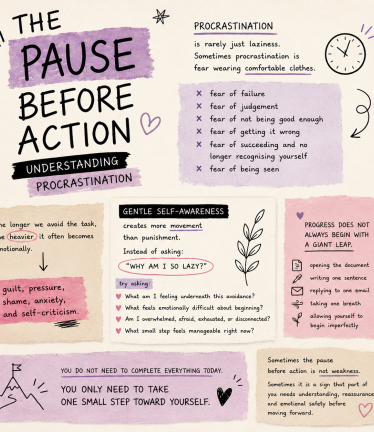
Procrastination is rarely just laziness.
Sometimes procrastination is fear wearing comfortable clothes.
Fear of failure.
Fear of judgement.
Fear of not being good enough.
Fear of getting it wrong.
Fear of succeeding and no longer recognising yourself.
Fear of being seen.
The longer we avoid the task, the heavier it often becomes emotionally. What may have started as a small responsibility can slowly grow into guilt, pressure, shame, anxiety, and self-criticism.
Many people silently carry thoughts such as:
- What if I fail?
- What if it’s not good enough?
- What if people judge me?
- What if I disappoint myself?
- What if I cannot cope once I begin?
Procrastination can sometimes act as emotional protection. Delaying the task delays the discomfort attached to it. For some people, procrastination develops from perfectionism, self-doubt, burnout, overwhelm, anxiety, or earlier experiences of criticism and pressure.
When we constantly feel we must perform perfectly, even starting can feel emotionally exhausting.
At times, procrastination may also reflect emotional exhaustion rather than lack of motivation. When individuals feel emotionally overwhelmed, disconnected, unsupported, or mentally drained, even simple tasks can begin to feel heavy.
The inner critic often becomes louder during procrastination:
- You should be doing more.
- Why can’t you just get on with it?
- Everyone else seems able to cope.
- You are falling behind.
But harsh self-criticism rarely creates sustainable motivation. More often, it increases anxiety, avoidance, shame, and emotional paralysis.
Gentle self-awareness can create more movement than punishment.
Instead of asking:
Why am I so lazy?
it can sometimes help to ask:
- What am I feeling underneath this avoidance?
- What feels emotionally difficult about beginning?
- Am I overwhelmed, afraid, exhausted, or disconnected?
- What small step feels manageable right now?
Healing procrastination is not always about becoming more disciplined. Sometimes it is about developing greater emotional understanding, self-compassion, and realistic expectations of ourselves.
Progress does not always begin with a giant leap.
Sometimes progress begins with:
- opening the document,
- writing one sentence,
- replying to one email,
- taking one breath,
- or allowing yourself to begin imperfectly.
You do not need to complete everything today.
You only need to take one small step toward yourself.
Reflection Questions
What emotions tend to sit underneath my procrastination?
- What am I afraid might happen if I begin?
- Do I associate productivity with self-worth?
- What would a gentler approach toward myself look like?
- What is one small step I could take today without pressure or perfection?
Sometimes the pause before action is not weakness.
Sometimes it is a sign that part of you needs understanding, reassurance, and emotional safety before moving forward.