Categories
Anxiety & Overthinking Emotional Awareness Emotional Wellbeing Mental Health Personal Growth Self-Reflection

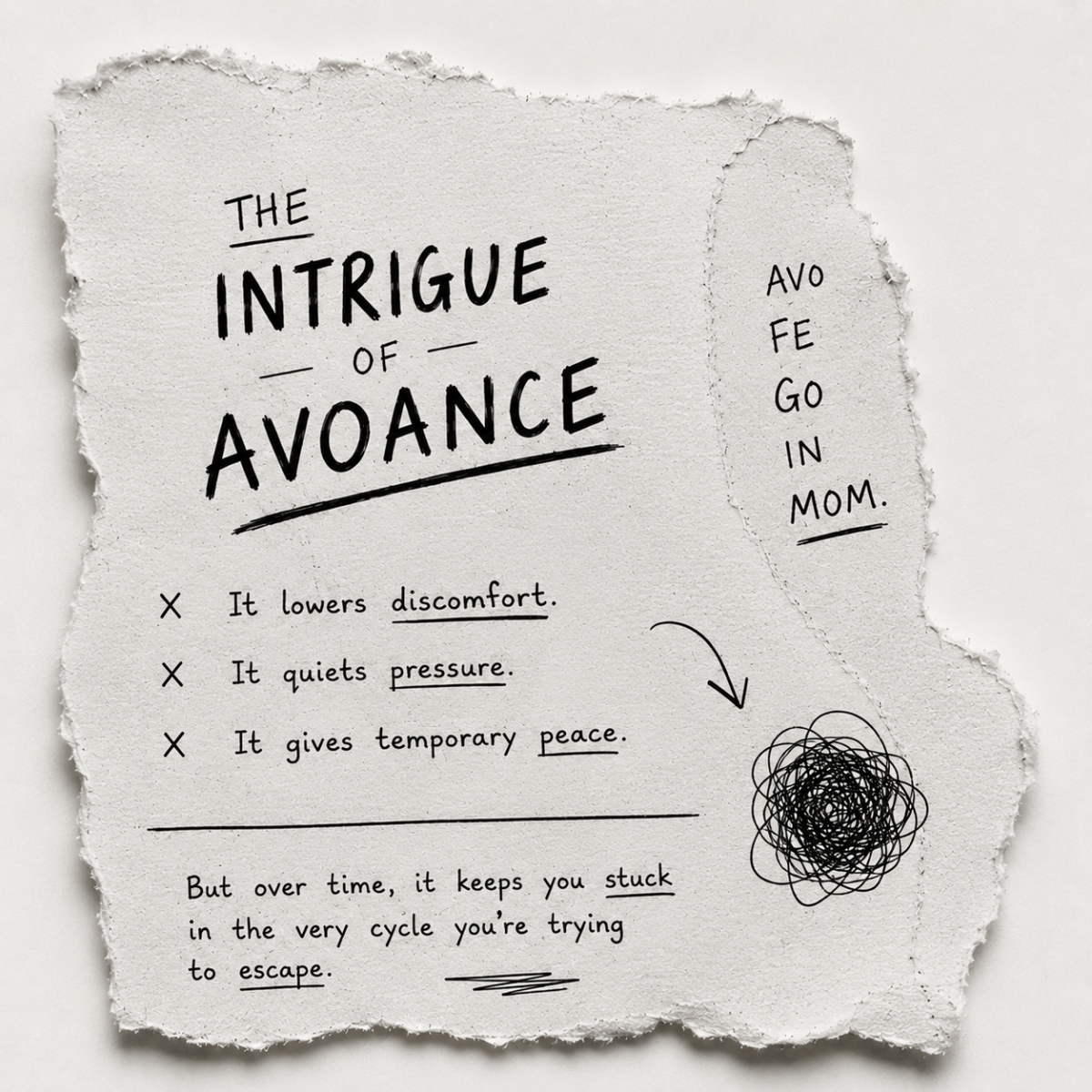
The Intrigue of Avoidance


Avoidance often feels good in the moment.

It lowers discomfort.
It quiets pressure.
It gives temporary relief from difficult emotions, responsibilities, conversations, or fears we do not yet feel ready to face.

But over time, avoidance can quietly keep us stuck in the very cycle we are trying to escape.

The more we avoid:

  • the heavier things can begin to feel,
  • the louder anxiety may become,
  • and the harder it can feel to begin again.

Avoidance is not always laziness or lack of motivation. Sometimes it is emotional protection.

Sometimes we avoid because we feel overwhelmed.
Sometimes because we fear failure, judgement, rejection, conflict, or disappointment.

Gentle awareness can help us notice what sits underneath the avoidance rather than simply criticising ourselves for it.

Creative Reflection Questions

  • What am I currently avoiding emotionally?
  • What discomfort am I trying to escape?
  • What feels difficult about facing this situation?
  • What might happen if I took one small step instead?
  • What would a gentler response toward myself look like today?

Sometimes healing begins not with forcing ourselves forward, but with understanding what is making us stay still.

Categories
Anxiety & Overthinking Emotional Awareness Emotional Wellbeing Mental Health Motivation Personal Growth Reflective Practice Self Compassion

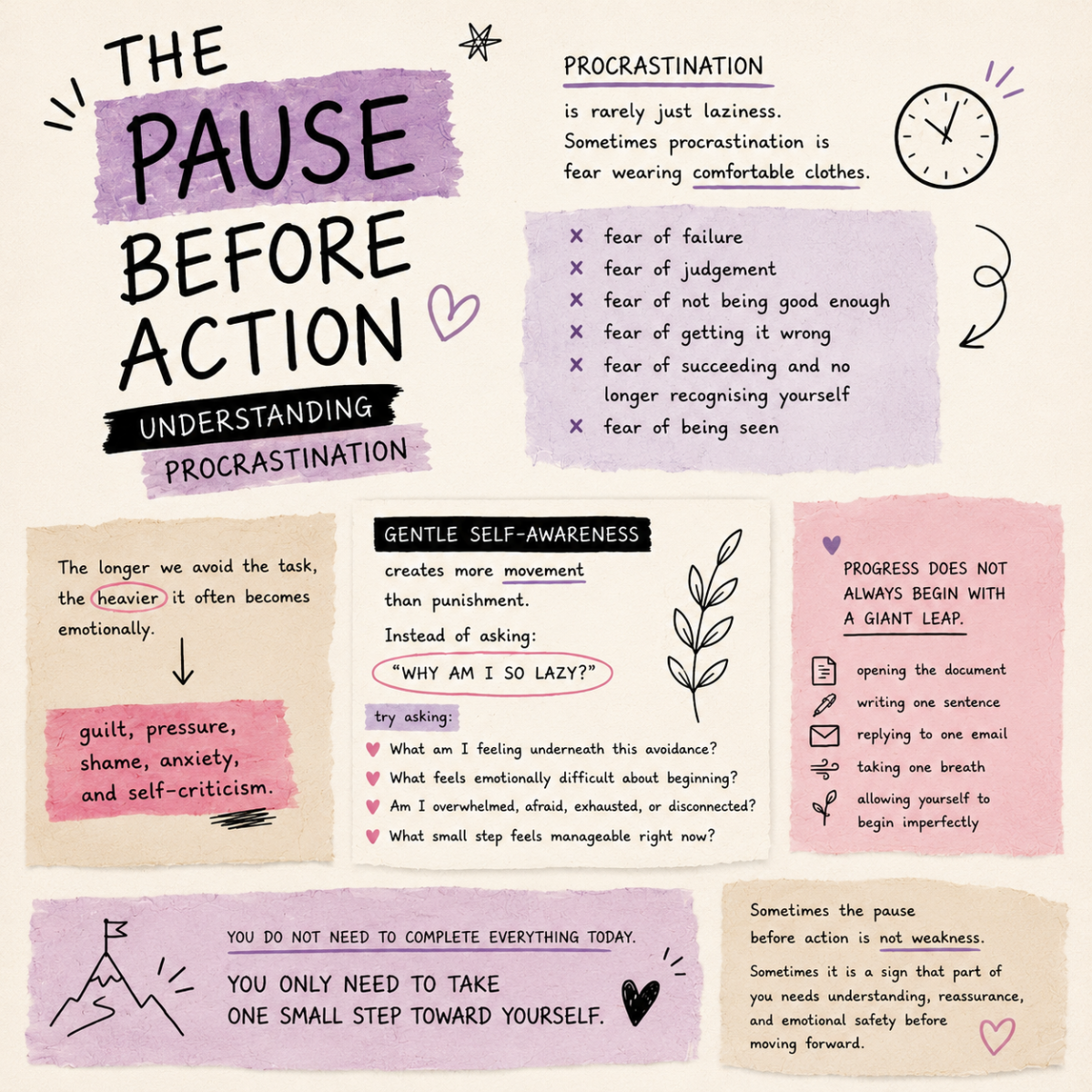
The Pause Before Action: Understanding Procrastination

Procrastination is rarely just laziness.

Sometimes procrastination is fear wearing comfortable clothes.

Fear of failure.
Fear of judgement.
Fear of not being good enough.
Fear of getting it wrong.
Fear of succeeding and no longer recognising yourself.
Fear of being seen.

The longer we avoid the task, the heavier it often becomes emotionally. What may have started as a small responsibility can slowly grow into guilt, pressure, shame, anxiety, and self-criticism.

Many people silently carry thoughts such as:

  • What if I fail?
  • What if it’s not good enough?
  • What if people judge me?
  • What if I disappoint myself?
  • What if I cannot cope once I begin?

Procrastination can sometimes act as emotional protection. Delaying the task delays the discomfort attached to it. For some people, procrastination develops from perfectionism, self-doubt, burnout, overwhelm, anxiety, or earlier experiences of criticism and pressure.

When we constantly feel we must perform perfectly, even starting can feel emotionally exhausting.

At times, procrastination may also reflect emotional exhaustion rather than lack of motivation. When individuals feel emotionally overwhelmed, disconnected, unsupported, or mentally drained, even simple tasks can begin to feel heavy.

The inner critic often becomes louder during procrastination:

  • You should be doing more.
  • Why can’t you just get on with it?
  • Everyone else seems able to cope.
  • You are falling behind.

But harsh self-criticism rarely creates sustainable motivation. More often, it increases anxiety, avoidance, shame, and emotional paralysis.

Gentle self-awareness can create more movement than punishment.

Instead of asking:

Why am I so lazy?

it can sometimes help to ask:

  • What am I feeling underneath this avoidance?
  • What feels emotionally difficult about beginning?
  • Am I overwhelmed, afraid, exhausted, or disconnected?
  • What small step feels manageable right now?

Healing procrastination is not always about becoming more disciplined. Sometimes it is about developing greater emotional understanding, self-compassion, and realistic expectations of ourselves.

Progress does not always begin with a giant leap.

Sometimes progress begins with:

  • opening the document,
  • writing one sentence,
  • replying to one email,
  • taking one breath,
  • or allowing yourself to begin imperfectly.

You do not need to complete everything today.

You only need to take one small step toward yourself.

 Reflection Questions

 What emotions tend to sit underneath my procrastination?

  • What am I afraid might happen if I begin?
  • Do I associate productivity with self-worth?
  • What would a gentler approach toward myself look like?
  • What is one small step I could take today without pressure or perfection?

Sometimes the pause before action is not weakness.

Sometimes it is a sign that part of you needs understanding, reassurance, and emotional safety before moving forward.
 

Categories
Emotional Awareness

Untangling Shame and Guilt

Untangling Shame and Guilt

Shame and guilt often get spoken about as if they’re the same thing, but anyone who has felt them knows they land very differently. Both can be uncomfortable, both can linger, and both can shape how we see ourselves, yet understanding the distinction between them can be the first step toward emotional clarity and healthier self‑reflection.

What Shame Feels Like

Shame is deeply personal. It is the sense that something is wrong with me.

It is not about a specific action; it is about identity. Shame tells us we are flawed, unworthy, or “not enough.” It pushes us inward, making us want to hide, withdraw, or disappear.

Shame often sounds like:

  • “I am a failure.”
  • “I am not good enough.”
  • “If people really knew me, they would reject me.”

Because shame attacks the self, it can be paralysing. It does not encourage growth; it encourages avoidance.

What Guilt Feels Like

Guilt, on the other hand, is about behaviour. It is the recognition that I did something wrong, not that I am something wrong.

Guilt can be uncomfortable, but it is also constructive. It points us toward repair, responsibility, and change.

Guilt often sounds like:

  • “I should not have said that.”
  • “I made a mistake.”
  • “I need to fix this.”

Where shame shuts us down, guilt can open a path forward.

Why We Confuse the Two

Shame and guilt often show up together, especially when we care deeply about how our actions affect others. A small mistake can quickly spiral from guilt (“I messed up”) into shame (“I am a terrible person”).

This shift is subtle but powerful, and it is where emotional overwhelm often begins.

Moving From Shame Toward Growth

The key is learning to separate who you are from what you did.

A mistake does not define your worth. A moment of poor judgment does not erase your value. When we can name guilt without collapsing into shame, we give ourselves room to learn, apologise, repair, and move on.

Some helpful reminders:

  • You can acknowledge harm without attacking yourself.
  • You can take responsibility without losing self‑
  • You can grow without punishing yourself.

Final Thoughts

Untangling shame and guilt are not about avoiding uncomfortable feelings, it is about understanding them. When we recognise the difference, we reclaim our ability to respond rather than react. We become kinder to ourselves, more honest with others, and more capable of meaningful change.