Categories
Anxiety & Overthinking Emotional Awareness Emotional Wellbeing Mental Health Motivation Personal Growth Reflective Practice Self Compassion

The Pause Before Action: Understanding Procrastination

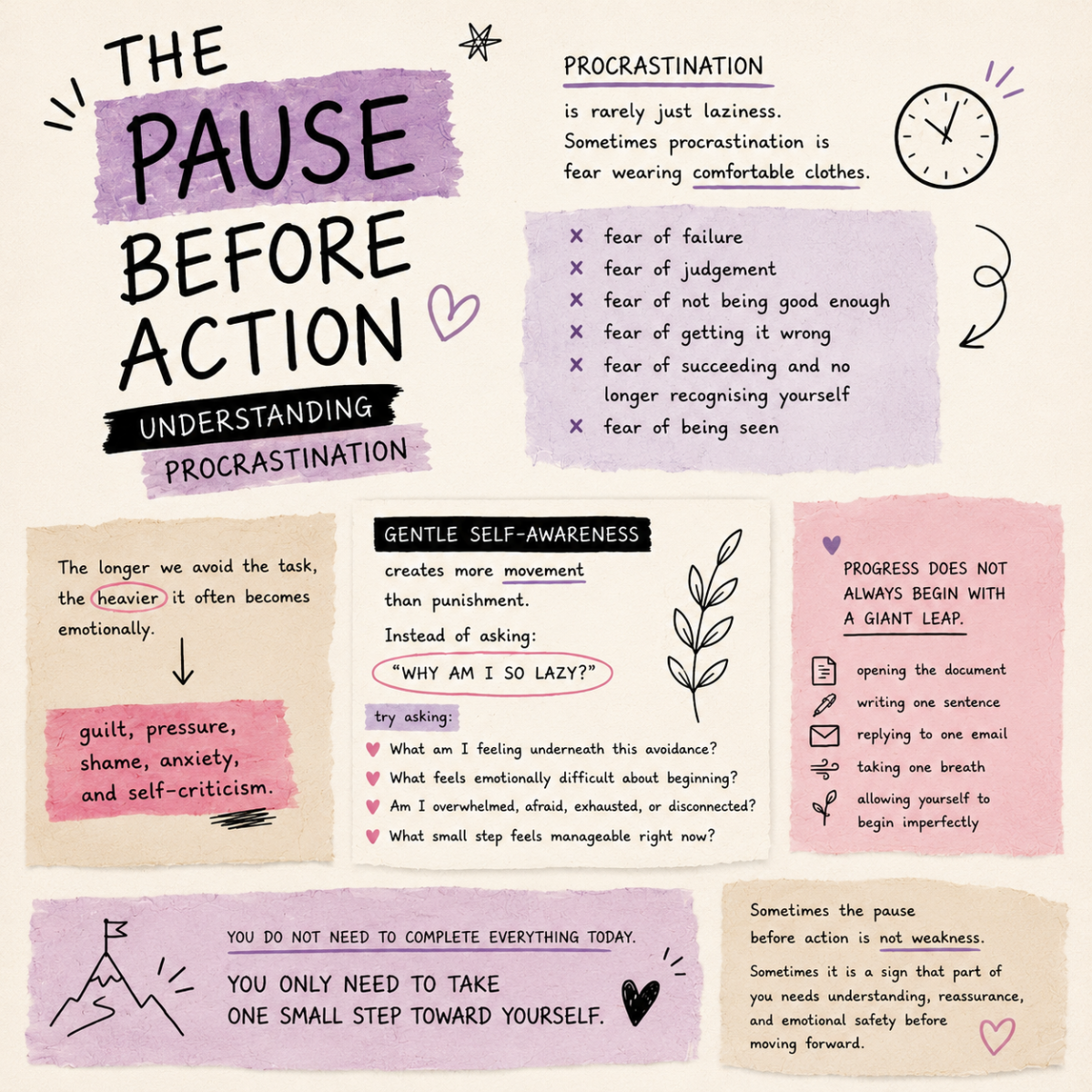
Procrastination is rarely just laziness.

Sometimes procrastination is fear wearing comfortable clothes.

Fear of failure.
Fear of judgement.
Fear of not being good enough.
Fear of getting it wrong.
Fear of succeeding and no longer recognising yourself.
Fear of being seen.

The longer we avoid the task, the heavier it often becomes emotionally. What may have started as a small responsibility can slowly grow into guilt, pressure, shame, anxiety, and self-criticism.

Many people silently carry thoughts such as:

  • What if I fail?
  • What if it’s not good enough?
  • What if people judge me?
  • What if I disappoint myself?
  • What if I cannot cope once I begin?

Procrastination can sometimes act as emotional protection. Delaying the task delays the discomfort attached to it. For some people, procrastination develops from perfectionism, self-doubt, burnout, overwhelm, anxiety, or earlier experiences of criticism and pressure.

When we constantly feel we must perform perfectly, even starting can feel emotionally exhausting.

At times, procrastination may also reflect emotional exhaustion rather than lack of motivation. When individuals feel emotionally overwhelmed, disconnected, unsupported, or mentally drained, even simple tasks can begin to feel heavy.

The inner critic often becomes louder during procrastination:

  • You should be doing more.
  • Why can’t you just get on with it?
  • Everyone else seems able to cope.
  • You are falling behind.

But harsh self-criticism rarely creates sustainable motivation. More often, it increases anxiety, avoidance, shame, and emotional paralysis.

Gentle self-awareness can create more movement than punishment.

Instead of asking:

Why am I so lazy?

it can sometimes help to ask:

  • What am I feeling underneath this avoidance?
  • What feels emotionally difficult about beginning?
  • Am I overwhelmed, afraid, exhausted, or disconnected?
  • What small step feels manageable right now?

Healing procrastination is not always about becoming more disciplined. Sometimes it is about developing greater emotional understanding, self-compassion, and realistic expectations of ourselves.

Progress does not always begin with a giant leap.

Sometimes progress begins with:

  • opening the document,
  • writing one sentence,
  • replying to one email,
  • taking one breath,
  • or allowing yourself to begin imperfectly.

You do not need to complete everything today.

You only need to take one small step toward yourself.

 Reflection Questions

 What emotions tend to sit underneath my procrastination?

  • What am I afraid might happen if I begin?
  • Do I associate productivity with self-worth?
  • What would a gentler approach toward myself look like?
  • What is one small step I could take today without pressure or perfection?

Sometimes the pause before action is not weakness.

Sometimes it is a sign that part of you needs understanding, reassurance, and emotional safety before moving forward.


Categories
Creative Therapy & Reflection Creativity and Healing Emotional Healing Emotional Wellbeing Reclaiming the Self Reflective Practice

The Things They Never Own

Many people suffer in silence, not because there is nothing to say, but because there is too much.

The image of a quiet suitcase, half-open, speaks for what words often cannot: the careful packing away of blame, denial, coldness, and control. The way shame is stitched into the lining while the outside remains polished and respectable. A suitcase, oval and elegant, sits quietly on the floor, open, but not exposed. Inside, small words rest where clothing might once have been avoidance, denial, protection, anger, blame, cold, abandon, integrity. Etched faintly inside the lid is one word that ties them all together — shame.

This image invites us to pause.

It asks what we hide, what we carry, and what we present to the world. The suitcase becomes a metaphor for the psychology of abuse, not just physical, but emotional, psychological, and relational. On the outside, it is polished and respectable; it looks harmless, even appealing. But open the lid, and we glimpse the defences, the distortions, and the pain that lie beneath.

For those who have experienced or witnessed abuse, this image speaks without needing to explain. The abuser often appears charming, warm, attentive, and admired. Beneath the surface, however, lie layers of avoidance, denial, and blame. They pack away their shame, disguising it beneath a façade of control.

Integrity, that fragile quality of wholeness, lies buried under the weight of self-protection. And yet, the suitcase is only semi-open. It suggests that the truth is never completely hidden. With awareness, with courage, with compassion, the lid can lift further — revealing not only the harm but also the possibility of change.

The task for the viewer is not to judge, but to see: to notice the dissonance between what the world sees and what lies inside; to recognise how often manipulation wears a smile. And to reflect on our own suitcase, what it holds, what remains unspoken, and what we are ready, or not ready, to unpack.

Reflection

For therapists, readers, and students alike, The Things They Never Own invites a deeper kind of seeing, one that goes beyond the surface.

Every person carries something unseen: defences, wounds, memories, inherited survival strategies.

Take a quiet moment to reflect or journal:

  • What does your own suitcase contain?
  • Which emotions or defences might you have packed away for protection?
  • What might you be ready to unpack, and what still feels too heavy to open?
  • How do you recognise the difference between what the world sees and what lies inside?

In therapy, supervision, and reflective practice, these questions remind us of the delicate balance between visibility and safety. To open the suitcase, even slightly, is to begin the work of integration and healing. When we dare to look inside with honesty and compassion, what was once hidden in shame can begin to transform into understanding.

May we learn to open only what we are ready to hold, and to hold it with gentleness.